surely

 Use Only As Directed


It’s pressing against the glass, blinking slowly, its body a bit tilted in what I interpret as concern.

It’s pressing against the glass, blinking slowly, its body a bit tilted in what I interpret as concern. ●


by Sarah Rakel Orton

Thank you for purchasing the most innovative and life-changing skincare product on the market: ENVISAGE®. Before you begin, carefully read the enclosed instruction booklet and use only as directed.

It doesn’t look the way it does online—it’s more alive, I guess. I cup it gently in my hand, stare back into its large, lidless eyes, pupils shifting from black to purple to deep navy. It seems to be studying me intensely. It’s a bit disconcerting, but the instructions say it will thoroughly analyze my face, so this must be what it’s doing. I poke its translucent flesh, startled by its narrowed expression.
          Once I’m in bed, I lay it carefully on my forehead, inhaling sharply at the cold, damp sensation of it settling onto my skin. I don’t know how I’m going to sleep like this—I keep thinking a slug is crawling on my face and I shudder involuntarily. I take deep breaths and think about the before and after pictures online, the transformation of acne-scarred, sun-damaged, and wrinkled skin into smooth, glossy prepubescent canvases. If this works, I don’t even care about my exorbitant credit card balance. I’ll never have to worry about insensitive women trapped in MLM schemes, examining my skin, making unsolicited suggestions when I’m just trying to buy shampoo. I can stop escaping into the bathroom after hook-ups to touch-up my foundation. Somehow, I adjust to it gliding along the contours of my face, and dream I’m throwing away every bottle of foundation cluttering my bathroom counters, the abnormally streak-free mirror reflecting a face so serene and radiant I look like a renaissance depiction of the Virgin Mary.

Results are not guaranteed and will vary by user. DO NOT use ENVISAGE® more than two weeks, as explicitly stated in the enclosed instruction booklet.

I lean into the mirror, my face an inch away, ignoring the dull ache in my abdomen as it presses into the bathroom counter. It’s been two weeks, and I think my scars are a bit smoother, and the discoloration on my cheeks and forehead seems more pink than red. But I don’t look like the after photos. I sigh when I remember the balance on my credit card, then push away from the sink, glancing at the little sealed cube I have to keep the thing in when I’m not using it. It’s pressing against the glass, blinking slowly, its body a bit tilted in what I interpret as concern. The normally clear body is shifting to a stormy gray, jiggling faintly.
          “I’m not upset with you. I just expected more, I guess. You did cost me an entire rent payment.”
          It compresses to half its size, turns away from me.
          “Don’t be sad! Should I even be talking to you? Have I lost it?”
         It doesn’t respond, and I turn the cube to face me, concerned. I peer into the cube, and exhale in relief when tiny indiscernible slits open, revealing downturned eyes, blinking mournfully.
          That night, I decide we need more time together if I’m going to get the results I paid for. 
      I remove it from its cube, surprised how quickly it responds to my touch, its body transforming to a sunset orange, jiggling exuberantly. I smile and place it onto my face, falling asleep quickly to its lively movements as it explores my skin with extra enthusiasm.

ENVISAGE® is not a pet or a toy. Do not become overly familiar with ENVISAGE®, as it has been engineered to perform one duty, and it is crucial to not confuse it. We are not responsible for any shifts in its behavior.

At first I think I’m still asleep, stuck in some perfect dream. I’m staring into the mirror, transfixed by my reflection: luminous, supple, the way I looked before puberty ravaged me. I rub my eyes, pinch my arm, and I’m still there. My laughter echoes, and I cup my tiny savior inside my hands, beaming. 
          “You’re incredible. Look what you’ve done! I can’t thank you enough! I knew two weeks wasn’t long enough!”
          It bounces enthusiastically, a bright pink, eyes curving into a facsimile of a smile.
        “You need a name. How about…Enid? My best friend in tenth grade was named Enid, and I was always so jealous of her skin. She never broke out, it was so unfair.”
          It nods, pink deepening.
          “You don’t need to stay in that cube anymore if you don’t want to. It looks so cramped. How does that sound?”
         Enid twirls, flashing from baby pink to fuchsia. That night, Enid nestles on my chest while we watch makeup tutorials on YouTube for hours. I tell Enid which makeup I’m going to buy once I pay off my credit card bill, until she reminds me with a gentle nudge to my chin that it’s time for bed.

● ● ● 

In the morning, as I stretch languidly, I realize I can’t feel Enid. Her morning jiggling, the signal that she’s completed our nightly facial routine, always wakes me up, so I scramble out of the sheets and rush to the bathroom, thoughts racing, imagining her dead or hurt, knowing I won’t get a refund if she’s damaged. I rush to the bathroom, heart hammering. She’s there, protruding from my forehead, as she should be, but eerily still, pupils dilated, body brilliant green. I shake my head, exhaling in relief, and smile at her indulgently.
          “Time to move, Enid!” I hold out my open palm, signaling her to jump, but she just blinks at me.
          “Come on! You know I have to go to work!”
          Unbelievable. She’s actually ignoring me.
          I glare at her and push my fingers against her jellied body, irritated when I realize she’s suctioned herself to my forehead. Grunting with effort, I yank hard, and she abruptly releases herself, wiggling mischievously when I nearly fall backward.
          “Okay, not cool, Enid. I think you need to spend some time in the cube.”
          She flushes deep red, eyes narrowing.

We are not responsible for any damage or injury resulting from failure to use ENVISAGE®as directed. 

I’m inking my lips with a new lipstick, a bright magenta I know will emphasize my now perfect skin. As I fill in my lower lip, my hand slips, and a stripe of pink lipstick lightly skims my chin. I roll my eyes, grab a tissue, and rub vigorously, startled by a rush of pain. Clinging to the tissue, a piece of sloughed-off skin, peach, pink, red. I stiffen in shock, staring at the tissue, my skin resembling a squashed insect. Panicked breaths shake my hands as I try to push it back onto my chin, but it just flops lifelessly into the sink. My eyes glide slowly back to the mirror, and raw red flesh glares back at me, blood painting my jaw.
          I look at Enid sitting on the counter, and she stares back at me, unblinking, blue as a spring sky. 
          “What the fuck, Enid? What just happened?”
          She turns away from me and settles onto the empty soap dish, eyes closing contentedly like a sun-soaked napping cat.

ENVISAGE® is explicitly intended for external use only. DO NOT consume ENVISAGE®. Keep out of reach of adults and children. Contact us immediately if ENVISAGE® is ingested. 

I wake with my mouth gaping like a dead fish, something thick and gooey on my tongue. I groan, try to reach for the glass of tepid water on my nightstand, but my cheek adheres stiffly to the pillow. Confused, I try to lift my head, but it won’t move. I push down on the bed, forcing my cheek and the pillow apart, and I scream, searing pain radiating across my entire body. Tentative fingers tap my cheek, slipping in soft, exposed tissue. My flannel pajamas are encrusted with dried blood, the inside fabric clinging to my body. I look down at my pillow, and for a moment, cannot understand what I’m seeing. A flayed sheet of my skin. I swallow, grimace at the odd chemical taste in my mouth, and with vibrantly red fingers, cautiously pick up my skin by a corner of what was my forehead. My stomach drops, shooting bile up my throat. My sagging face, eyebrows still attached, two lines of sparse eyelashes. I tumble from the bed, wincing at the sudden cold, and run to the bathroom, gasping for breath, feet unsteady like I’m moving on a freshly mopped floor. There’s the mirror. But where am I?
          My skin is gone. I unbutton my pajamas, peel the fabric from exposed muscle, deep maroon and vivid red, glistening, sculpted into stripes like woven fibers. Eyes blindingly white against a red landscape of abstraction. Then a voice behind me, oddly familiar.
          A figure stands beside me, and we watch each other in the mirror as she speaks. I barely hear her, mesmerized by her glowing skin, indistinct and thin, the nascent body wobbling with each movement of breath. Stubs of hair on a thin scalp, the same reddish-brown as mine, my round chin, same placement of freckles, each blinking into place, emerging from jellied skin as I watch.
          “What did you say?” I breathe, my voice raspy and weak, wanting desperately to lie down, to sleep, not think about what I’m seeing. 
          “I said, I don’t like the name Enid. I like yours more.”
        With a dreamy nod, I open my mouth, indistinct without the skin of my lips, but I’ve forgotten how to speak, and she’s so kind, guiding me to the floor, smiling down at me. She’s so beautiful. I’m so beautiful.

Sarah Rakel Orton is a writer and illustrator living in Salt Lake City. All of her hobbies involve sitting indoors, so don’t expect to find her enjoying any of Utah’s outdoor activities. Her stories have been published in The Sun Magazine, The Reprise, Mytholog, Prick of the Spindle, The Summerset Review, and Tales from the Moonlit Path.

 The Sunset


The sunset went anywhere it wanted.

The sunset went anywhere it wanted. ●


by Eleanor Ball

The day the sky split open, our windshields frosted over with rainbows. Shooting stars bounced like hail off the rooftops. It was hardly 8:00 a.m., but it felt like evening as the sky bled streaks of purple-gold sunset. 

The sunset spread across the road like watery batter, potholes sloshing with light. It seeped into unfinished basements, soaking the bottoms of boxes stuffed with dusty Easter decorations and VHS tapes labeled Patti’s birthday — 1991. Everything it touched turned a strange silvery-orange that you could only see if you were not trying to see it at all. 

The sunset went anywhere it wanted. It was the new sheriff in town. It had no concept of parcel maps or property lines and would not have respected them if it did. The sunset elbowed its way into the municipal water system, bursting out of washing machines and bathroom sinks. It spun honey-gold stars to dance across downed fence posts as they floated in a sunset sea.

All things considered, it was a public safety disaster. 

School was canceled. We worked from home, stuffing old rags under our doors in the hopes our bedrooms and offices might stay clean. Our children were transfixed in the way you are transfixed watching hurricane footage or apocalypse movies. They burst out of doors, running towards the sunset as fast as they could. Older kids helped babies and toddlers, who too were crawling and stumbling towards the sunset with the fervor of moths hurling themselves into a bonfire. After all day splashing in the roads, they emerged coated in the sunset’s oily sheen, which could only be removed with Dawn dish soap and more patience than any child has ever had. 

We texted each other warnings. 

Look out, or you’ll track in the sunset. 

We keep an orderly house—no sunset in here. 

Don’t touch your eyes, we told our children. Don’t lick your fingers,

or you will taste sugar so sweet it burns a hole straight through you, like a name no one has called you in years.

Eleanor Ball is a librarian and assistant professor at the University of Northern Iowa. Her work appears in Barnstorm, Strange Horizons, Yalobusha Review, and elsewhere, and she edits for fifth wheel press. Come say hi at eleanorball.bsky.social or eleanor-ball.com.


 What Becomes


When the house was dark, a pulsating glow would escape from slivered cracks in the stairs.

When the house was dark, a pulsating glow would escape from slivered cracks in the stairs. ●


by Garret Fopma

It was milky-white, as it had always been, but on this particular day there was a shimmer in the slime. It was opalescent or pearlescent; Adam could never remember the difference. It was an illusion, he thought, a trick of the eye, a trick of the light. He knew this, but he still couldn’t shake the shine. 
          It felt alive, as if there was something in there, something other than his suffocating sperm. He knew, of course, that it couldn’t be living. But he was also certain that it had never looked like that before. Adam stood in the bathroom with his pants around his ankles, staring until it dissolved into the wad of toilet paper in his hand.
          The next time it was the same.

● ● ●

The doctor told him they couldn’t find anything out of the ordinary. Adam shifted uncomfortably and the examination paper crinkled and cracked under his weight. It had been anything but ordinary, he told himself. He’d witnessed it with his own eyes, several times now. He had produced a specimen for his own personal examination every day until the morning of his appointment. He was surprised that he had anything left when it came time to provide the official sample, but sure enough, he had seen the same shimmer in the cup just before he’d handed it to the nurse.
          “What about the color, the shimmer?” Adam asked the doctor.
          “We didn’t see anything out of the ordinary,” the doctor repeated. “Maybe it was the light playing tricks. Granted, it is a fascinating substance, but I’ve never seen anything about semen having a shimmer or a shine to it.”
          “So, what do you suggest?”
          “Suggest?”
          “Well, yeah,” Adam stammered. “I mean, what should I, you know, do about it?”
          “There’s nothing to be done. You have perfectly healthy semen. If it starts to change color, actually change color, or if you find blood or start feeling pain when you ejaculate, call the office and we’ll take another look. But for now, there’s nothing else we can do.”
          The doctor patted Adam on the knee, stood up and turned for the door. Adam shifted uncomfortably again, subconsciously adjusting his crotch. The doctor stopped and turned back.
          “Look, I can’t give you any more medical advice.” He paused for a moment. “But if it were me, I would maybe stop staring at it so much and try to get out there and find someone to share it with. You know what I mean?”
          Adam nodded, but he couldn’t share it with anyone else until he understood it better. And he couldn’t understand it better until he had more.
          Adam decided that it needed moisture. He knew that any living thing on Earth needed water to survive, so if it were alive, it would need a moist environment. He placed a glass of water on the counter next to the toilet. He knew it was odd. He knew no one was going to just happen upon his experiment. He knew no one would come to his house, unannounced or not. But he was still afraid of what someone might say or think. Shame is a powerful deterrent, but something strange was happening, something he could not erase from his memory. So, collection began in earnest.

● ● ●

After a few days, it needed more space, so Adam clumsily transferred it to a bowl. But when that had filled faster than anticipated, he began to question the experiment. The sample had grown thanks to his own diligence and determination, but he had yet to observe any significant changes. It still shimmered the same as it had before, and it sometimes had the appearance of movement, but that was to be expected of a viscous, congealed mass sitting in a bowl of water. Perhaps the doctor was right, he thought, perhaps there is nothing out of the ordinary. Then again, maybe it just needed a little more. Another week of collections couldn’t hurt.
          Resolving to continue, Adam settled on the next vessel, a bucket. But the larger the vessel, the larger the specimen would become and he couldn’t keep a bucket of slime in his bathroom. It would need more space to thrive and a safe place to hide, so Adam carried the sloshing bucket to a small storage closet under the stairs. The space was large enough for him to crouch into, but the slope of the staircase and the supporting structure made it difficult to stand up straight or store anything large, so it had become a waystation of household miscellany and cleaning supplies.  

● ● ●

The move to the storage closet under the stairs proved a masterstroke. The darkness seemed to make the shimmering brighter, more profound, and the subtle movement he thought he had seen before became intentional, captivating. Adam would sit for hours losing himself in the grace of its movement and the bright, unfamiliar glow of the familiar substance. And much like a fungus or a mold, the lack of light seemed to encourage growth. Each deposit congealed and coalesced much quicker than it had before.
          Yet all these exciting breakthroughs led to a new, unsettling complication. It, whatever it was or was becoming, wanted more. Adam could not explain how he knew what it wanted, he could only sense it. As the substance grew and developed, so did some ancient paternal instinct. The movement would grow upsetting, more aggressive, like a frenzied shark thrashing in chummed waters. When the house was dark, a pulsating glow would escape from slivered cracks in the stairs. It was a call, a request. It was a hunger that was becoming insatiable.
          Adam felt his own power, his autonomy, steadily slipping away from him. More and more of his time was spent feeding and caring for this thing he had created. He wasn’t certain he was growing a lifeform, but it was, at the very least, something that resembled it, and that responsibility required time and effort. Of course there was doubt, there was always doubt, but he had decided that he could not look at himself in the mirror if and when he decided to throw the baby out with the bathwater. 
          He needed more, it needed more, but he could only make deposits when he was at home, so Adam began taking small, empty containers with him to the office. Throughout the day he would find a quiet place to make a deposit that he’d store in a refrigerated lunch bag until he went home for the day. 

● ● ●

Nothing could keep his interest any longer. Everything else became unimportant, irrelevant. If Adam wasn’t sleeping or eating or working, he was feeding it and watching it grow. It was still mostly amorphous, but occasionally it formed a shape that resembled a fetus in the womb, or some slimy deformed animal found only in nightmares.
          The demands were beginning to take a toll on Adam’s body. He stopped exercising and going out of the house except for work. Some days he would forget to eat or sleep. He lost track of time, sometimes missing entire days of work because he couldn’t drag himself away from the closet under the stairs. Anyone else might have called it an addiction, but there was no high to chase, no adrenaline rush. It was dedication. He was creating something, and that required sacrifice. Time, energy, responsibilities, happiness; these were all expendable when compared to the glorious act of creation.
          When it had outgrown the bucket, Adam bought a plastic swimming pool. It was a pool for children, less than a foot deep with little sea creatures printed all over the stiff blue plastic, but it fit perfectly in the closet under the stairs.
          He’d read somewhere that some plants only grow within the confines of the spaces they are given. A modest pot might keep some plants small, but plant them in the ground, in an open field, and they spread like wildfire.

● ● ●

Adam didn’t know how many weeks it had been since the experiment had begun. The days were bleeding into one another, and he existed in a perpetual and inescapable state of exhaustion. Nothing excited him; there was nothing left on the face of the planet that could arouse him. Any shred of happiness he had derived from the extraction process had long been extinct.
          But now he had reached a point where he physically could not continue. He was chafed and bright red, skin cracked and bleeding. He moisturized daily, took cold showers and ice baths, but no matter what remedy he applied, he couldn’t walk more than a few steps without searing pain. He fantasized about chopping it off, destroying it, anything to save himself from the suffering and despair.
          He had reached his limit.

● ● ●

It had been four days since he had opened the door to the storage closet under the stairs. He knew he had gone too far, that he had sacrificed too much, but it was too far along now; it was a living thing. Perhaps it had always been alive, but now it was something altogether unique. He couldn’t bring himself to just pour it down the drain or flush it in the toilet, it had grown too massive for that. He had hoped that it would starve or suffocate after a few days of neglect, but the nightly glow hadn’t grown any dimmer in the days that passed. 
          There was water seeping out from under the door. The cheap plastic pool had broken, he thought. Perhaps it had collapsed and cracked the pool. He wanted to believe it. He wanted to believe any number of stories he could tell himself. But he knew. He knew it was still there. He knew that it had outgrown the pool. He knew that he could not destroy it, that it would outlive him. He knew that when he died, this would become his legacy.
          Adam opened the door and crouched down until he was face-to-face with the thing. But it was no longer a thing, it was him. The height, the shape, the proportions; it was like staring into a foggy mirror. The details were blurry, ill-defined, but there was no mistaking it, he was looking at his own reflection.
          When he moved, so did the wet version of him. The way he craned his neck, nervously cracked his knuckles; all his previously imperceptible tics and idiosyncrasies were on display. It had been studying him, observing his mannerisms and the way he moved. Each time he had opened the door for feeding, it had learned something new about him and imprinted it onto itself. It crouched down in the blue plastic pool, water sloshing onto the floor, imitating his every movement like some soggy milky-white mime.
          His features became clearer, more defined as the creature took shape. Pale skin began to harden around the wet body. Nails formed on each of the ten fingers and toes. Hair sprouted in the exact same places from head to toe. It was like watching a polaroid self-portrait slowly coming into focus.
          The face was last. The skin hardened and wrinkled. Had he always looked this old, he thought, or had he sacrificed any vigor and vitality he had to breathe life into this version of himself. An expression formed on the face. Eyes wide, mouth agape, lips trembling. It was a look of sheer terror, his terror, reflected back at him in exquisite and excruciating detail. 
          Adam raised a hand and waved to himself.

Garret Fopma lives in Los Angeles where he writes weird fiction and occasionally works in television.


 Compounding Pharmacy


The people the blob encountered only watched the blob slide to the floor without lifting a finger to help. Except George.

The people the blob encountered only watched the blob slide to the floor without lifting a finger to help. Except George. ●


by Callum Angus

The blue blob slorped and glorped toward her. The hospital’s fluorescent lights reflected glistening white rectangles off its irregular surface—it looked smooth, not sticky, like it might be soft to touch, like a dolphin at Sea World. As tall as a linebacker, up close she had to look up to see where the blob’s head might be, shimmering and jiggling like a summer Jell-O. Instead of a nose it had a protrusion over which two depressions hovered like sockets, empty of eyes. The suggestion of arms and legs branched off from the trunk, but stumpy with the absence of fingers, hands, or feet. It wavered in front of her, uncertain, so tenuous among its surroundings. Despite the lack of any noticeably human features, its ungainly movements and the way it hunched over itself was enough. She could tell it suffered. 
          “I don’t feel so good,” it said, although it was difficult to say how. Its voice was indeterminate of gender or age, but it reminded her of people she’d known. And then it began to fall. She reached out to catch it on its slow descent to the linoleum. It was heavy heavy heavy, and as she took more of its weight she could feel a twinge in her lower back that vibrated through the rest of her body. The blob slumped to the floor where its collection of limbs blended into one pitiful mass unconscious at her feet, or so it seemed. Its mirrored surface shimmered as if tickled by a sea breeze, but she couldn’t see herself reflected. Where her body should have been was just an empty hospital corridor leading nowhere. 
          “Not again, George.” A voice sighed in frustration as George removed her headset. Outside the virtual training module her awareness returned to a gray bureaucratic room with plastic chairs on wheels and whiteboards covering three out of four walls. RN Jackson stared at a laptop and made a few strokes on the keyboard, frowning, while his assistant helped remove the velcro from the sensors strapped around George’s middle. Her classmates judiciously pretended to be absorbed by either their phones or their computers, while the blob quivered on the projector screen above the classroom. 
          “Sorry,” muttered George. Jackson removed his glasses and pinched the bridge of his nose.
          “This is a pass-fail class, George, but you need to understand: this is meant to train you to not reach out and catch a 300-pound patient who falls to the ground in front of you. You’ll hurt yourself, badly. And then you won’t be able to help anyone.” 
          “I don’t do it consciously. It’s like a reflex. I can’t help it.”
          “We’ll try again next week,” said Jackson, and the rest of the students groaned. Earlier in the semester every one of them had successfully failed to reach out and catch the blob on their first try, and watching George catch the blob over and over in the intervening classes had grown tedious. They’d moved on to other trials. They listened to irregular heartbeats and tried to identify arrhythmias. They’d steeped virtual tea while trying to remember how many sugars each family member took, besieged by a slow creep of dementia (to build empathy, Jackson had insisted, though George was mostly annoyed at the virtual adult children and their babying demands). But a few minutes were always saved at the end for George to try to fail to catch the blob.
          George knew the correct stance she was meant to take in the training exercise. It was a lunge, one foot out in front of the other to allow the patient to slide down her body gradually, if possible. George thought it looked like she was trying to trip the fainter, though she understood that the training was meant to disillusion her of the notion that certain actions or body positions indicated a predisposition to help or to hurt. Intellectually, she’d absorbed this lesson, a long time ago even. On the train home when she passed the oversized billboard with a newborn’s tomato face and the text FINGERPRINTS AT 9 WEEKS, George understood that this seemingly compassionate diorama was actually a bespoke kind of evil, and she was seized by the desire to add to the infant’s spraypaint tattoos. Even more complex calculations awaited when the bus trundled past the park where several RVs without wheels sported American flags from every corner, a ragged patriotism that had become its own home devoid of shelter, food, or care, but flush in a sense of belonging and violence. But George’s fluency in deciphering these discrepancies stopped at the hospital doors. Add the wounded flesh of people into the mix and it became a smokescreen. It didn’t help her when faced with the blob, which had been programmed to look as inhuman as possible to circumvent the trainee’s mirror neurons. George still felt for it. In nursing, empathy was considered a treasured quality to be sheltered and cultivated like a greenhouse plant, but George had always felt hers was out of control, overgrown, wrapping around any pillar of feeling it could find in its random groping. Most days it felt like only a matter of time before her empathy strangled some delicate plant of lesser strength. She feared her own care. 
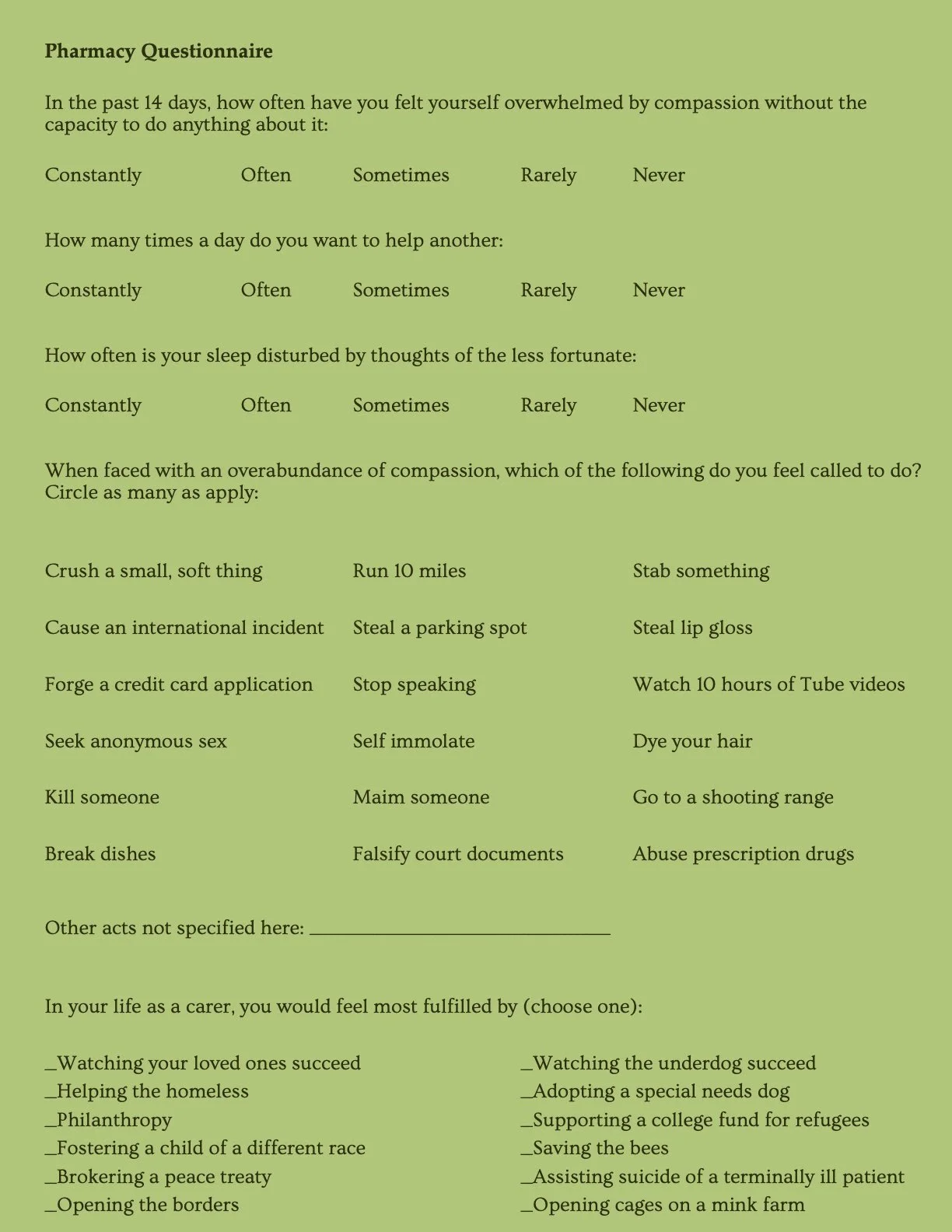
          George stepped through the train doors at her stop, which was across the street from a Walgreens. She hated going inside—most of the everyday items she might need, like deodorant, chapstick, cough medicine were locked behind plexiglass cases, and shopping meant tagging along behind a beleaguered employee with a jangle of keys going from box to box, anxiously scanning the brands while they waited, a queue of customers growing angry at the register because no matter how many football fields could fit inside the store, there only ever seemed to be one person on duty. Today, however, she needed only shampoo, which remained unsecured on the bottom shelf toward the rear right corner of the store. As she stooped to retrieve it, an illuminated sign caught her eye—not neon and therefore custom, but an aluminum box filled with mostly lit bulbs, overlaid by a red transparency with the letters cut out to read “COMPOUNDING PHARMACY.” Some of the red had chipped off, giving the letters the weathered appearance of an ancient tongue. George had never noticed the sign before. Below its flickering message was an old man with the bushiest gray mustache George had seen outside of a black and white photo. He noticed her right away and his eyes sparkled from behind gold-rimmed glasses. 
          “We’re a compounding pharmacy. That means we can tailor medications to your specific needs.” His speech was a bit too close to the cadence of a sideshow conductor. 
          “I know what a compounding pharmacy is. I guess I’ve just never … needed one before.”
          “Most people don’t know when they need one. Here,” he handed her a form. “Fill this out. It helps us calibrate your specific medication needs.”
          “Thanks, but I’m busy today.”
          “It only takes a few seconds. Or just bring it back any time. I’ll be here.”
          George took the sheet to be polite and proceeded to the register at the opposite end of the store. After telling the clerk that no, she did not have a Walgreens card, she broke script and asked about the compounding pharmacy.
          “That’s Seth’s gig,” she said. “He doesn’t get much business. It’s a holdover from when we merged with the local pharmacy.”
          “Walgreens does mergers? Isn’t it more of a seek-and-destroy kind of mission?”
          She rolled her eyes, and George stepped aside to let the impatient line of customers proceed.

● ● ●

“Why do you catch me, George?”
“I don’t have a choice. It’s what my hands do.”
The blue blob didn’t seem to accept this answer. It quivered with displeasure. 
“I think—I think I care too much.”
“You’re not supposed to care about me, George. That’s why I look the way I do.”
“Are you capable of empathy?” The blob considered. No one had ever asked the blob such a question before. The people the blob encountered only watched the blob slide to the floor without lifting a finger to help. Except George. 
“I’m not sure. No one seems to care if I fall. Why should I care about them?”
“You don’t have to care about people. You can care about other things. Birds, for instance.”
“I don’t think there are any birds here.”
“I guess you’re right. No one thought to add a bird. It’s a shame.”
“A shame,” mimicked the blob. 
“There is this one flickering light, though,” the blob continued. “Its long fluorescent tube flicks on and off in a lovely pattern. I can feel it fluttering its code in the reflection off my body like a moth lost in flame. Like butterfly kisses. I feel bad for it, that it has to be stuck here where no one will come fix it.”
“How do you know about butterfly kisses?” 
The blob considered. “I’m not sure. I just do. Maybe the light told me.”

● ● ●

On Christmas Eve two months ago George answered a knock on her door. She lived alone in a small apartment in which every room connects to every other room, but she had her own door to the outside world without a hallway or stairs between her and the sidewalk. In her temperate corner of the country it rains on Christmas, as it was doing so when she opened the door. A woman stood there without a bag or jacket, strawberry blond hair damp and growing matted, a cut to the bridge of her nose healing badly. This was how she met her roommate Chrissy. George fed her leftovers. Chrissy asked to sleep on George’s couch—“It looks so comfortable,” she’d said, longingly stroking its corduroy upholstery—and George couldn’t bring herself to turn her back out into the cold. George wasn’t raised with religion, but Chrissy’s timing made it difficult for her to feel she wasn’t being tested like the people who’d turned away Mary and Joseph before the birth of Christ. She was pretty sure those people had had a good reason for turning away strangers in the dead of night in a desert town, likely better than any she could muster for herself with a whole apartment and a full fridge to herself. So she’d let Chrissy stay, and Chrissy had been sleeping on her couch ever since, with George playing a mix of lover, father, and case worker.
         “Apply for any jobs today, Chrissy?” This was George’s opening line after she got home and found Chrissy sunk into the couch, episodes deep into another teen drama binge on George’s laptop. Chrissy snorted.
          “Oh sure, they’re lining up to hire a high school dropout with no ID and one pair of pants.” Her hand rustled inside a bag of potato chips.
          “I told you you could borrow some of my clothes for an interview,” said George, sitting across from Chrissy on the ottoman while she removed her thick-soled sneakers.
          “Can I borrow your face, too?” Chrissy grimaced, showing off her teeth, most of which tried to go in different directions. George didn’t know if Chrissy’s dental problems were the result of neglect, or neglect after an accident, but Chrissy mumbled most of her words through her half-closed mouth to avoid showing them to anyone. She only put them on display to make a point.
          “It’s not a customer service mouth, that’s true,” said George, snagging a potato chip. “But there are plenty of call centers hiring all the time. I can help you put a resume together,” she said hopefully.
          “No phone,” said Chrissy.
         “I’m pretty sure they give you one,” but Chrissy had gone nonresponsive, as was her way during these conversations. George was at a loss. She couldn’t understand how things had ended up this way, where she felt like an interloper in her own home. Chrissy looked so unbothered by her presence or the fact that she was eating someone else’s food, wearing their clothes. George felt no anger. She just wished she could know what that felt like.

● ● ●

“Do you know where we are?” 
“Yes,” burbled the blob. “This is the Intensive Care Unit.”
“But what’s outside of that? Have you ever looked out the window?”
George and the blob turned to the glowing rectangle in the wall. It looked like a square through which natural light filtered and illuminated the room. 
“It’s a bright and constant light out there,” said the blob. “I don’t like it.”
George had to admit that the windows in the computer-generated hospital were ominous, as if looking out of them revealed that she and the blob were suspended inside of a simulated sun. She turned around to where the blob stood beneath the flickering fluorescent light. The blob had no face, but its posture indicated that it was considering the light deeply. 
“Do you know morse code?” George felt silly asking but she didn’t think the blob could judge her.
“No,” said the blob, whose reflective surface shone bright then dark then bright again in the fussy illumination from the flickering light. “I don’t think it’s trying to communicate with me.”
I’m trying to communicate with you, George wanted to say, but she felt this too obvious, even if the blob couldn’t understand her. Especially because it couldn’t understand her. 

● ● ●

Seth’s mustache wriggled in excitement when George handed him her questionnaire. 
          “Splendid! Just a moment.” He disappeared behind a pile of boxes so that George could only see his company-issue red vest peeking out from behind a clear plastic bag filled with amber prescription bottles like a goblin’s treasure. Such a thought was uncharitable, thought George, which maybe reflected that Seth’s promised therapy was already working. 
          After several minutes of the hollow sound of pills rattling from their containers and into other containers, Seth emerged triumphant and held out to George her prescription. It resembled her antihistamines.
        “I’m no alchemist,” said Seth. “All pills look the same on the outside. A miracle of modern medicine. Any time you feel you’re drowning in compassion, just pop one of these babies. Preferably after a full meal. You can still operate heavy machinery, provided it’s in a large parking lot with plenty of space to maneuver.”
          “I don’t drive,” said George.
          “Even better!” 
          George took the bottle of pills and left. 

● ● ●

“All I do is fall, George,” said the blob. “Maybe I don’t need someone to catch me. But I’m scared. I want to be cared for.”
“If I was just another patient in this fake hospital, I wouldn’t care about what happens to you,” said George. “I’d be so absorbed with my own pain and suffering that I’d let you fall. I wouldn’t even know you were there.”
“Patients aren’t supposed to care about each other,” said the blob, nodding slowly. “We ache and we groan and call out for help. But we don’t help each other. We can’t, because we’re patients. We are acted upon.”

● ● ●

After George had been taking her new prescription regularly for several days she woke in her dark room to the sound of Chrissy sobbing. She was speaking to someone, accusing them of lying to her and sabotaging her attempts to get well, although George understood if she were to go out there it would be just the two of them. She wondered where Chrissy would have gone had George not let her stay, if her generosity had merely delayed the inevitable, or even forestalled the possibility of Chrissy finding stability on her own. She wondered, not for the first time, who had let Chrissy down so ferociously, or what harm of her own doing she was running from. George listened from behind her closed, hollow-core door. Chrissy made no attempts to hush her keening wails; it was clear to both of them that George could not possibly still be asleep. And yet she remained in her bed. She had only a vague feeling that she’d done something wrong. There’d been no change to her internal monologue that she could notice. She still felt for Chrissy, but she had no desire to alleviate or fix her suffering. She’d gone back to the pharmacy to ask Seth if her medication was working properly, if in her journey to reduce her compassion she’d stalled out at pity. But there’d been no sign of his kiosk, just a bland institutional corner with gray carpet and crumbling tile next to a shelf of condoms locked behind plexiglass. 

● ● ●

“I’m going to let you fall.”
“I understand,” said the blob. “It’s why I don’t have a face, why I was created. To suffer and not be helped. Because it helps you.”
“Faces make it harder to withhold empathy,” nodded George. 
“I don’t feel so good.”
She watched the blob sway in front of her. She thought about grabbing one of the low-poly scalpels on the table near her hand, bringing it down with force on the blob’s exposed surface. Would it pop, or just slosh out slowly? But the program wouldn’t allow her to cause harm. Only watch or catch. In one fluid motion she crossed her legs and sat on the floor. 
“I’m just going to watch,” she said. “I’m here for you.”
The blob began its journey to the floor. Its back and forth movement obeyed the currents of an invisible storm, first one way, then the next, until no more attempts at balance could be made. George’s hands itched. The desire to reach out and catch the blob stormed just under her skin. Its blue bulk loomed over her, a tsunami of pain. She closed her eyes and prepared to feel, for the first time, nothing.


Callum Angus is the author of A Natural History of Transition (Metonymy Press), CATARACT (Fonograf Editions), and the forthcoming Stream: Life in Flux (Northwestern University Press). He lives and writes in Portland, Oregon, where he publishes the journal smoke and mold, and teaches online at celiumlit.net.